How to move your research panel to a new system without losing the participants you worked hard to recruit.
.png)
Migrating your research panel to a new system can be a daunting task, with the potential to lose valuable participants if not handled properly. To ensure a smooth transition and maintain the integrity of your panel, careful planning and strategic communication are essential.
This guide outlines best practices for panel migration, leaning on Great Question's experience migrating hundreds of research panels, with a focus on minimizing the loss of participants.
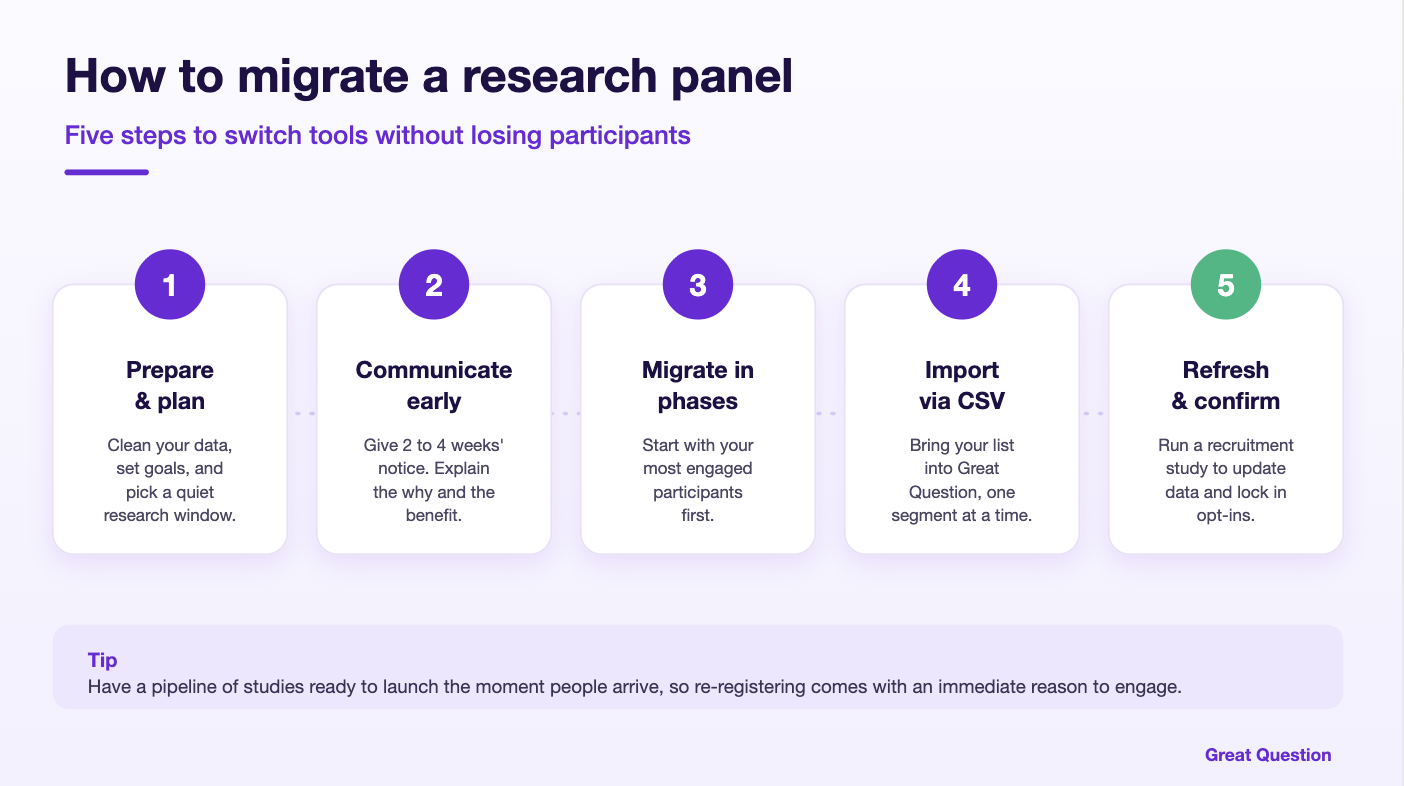
Data quality check. Ensure your current panel data is clean and up to date. Consider using data cleaning tools or services to identify and address inconsistencies or missing information. Here's a quick primer on data cleaning.
Participant engagement analysis. Identify highly engaged members and those at risk of churn. Analyze factors like recent activity, survey completion rates, and time since last participation. Segmentation analysis can help identify at-risk groups based on specific criteria, for example low activity in the past six months.
Enrich your data (optional). Consider using this opportunity to supplement your existing data with additional information from external sources. This could include demographics, interests, or purchase behavior, coming from places like Salesforce, HubSpot, or your data lake. Some teams also choose to engage external data enrichment sources such as Clearbit or ZoomInfo to check email deliverability and gather additional information about their participants.
Migration objectives. Clearly define what you aim to achieve with the migration. This will probably include things like improved research functionality, better data security, or a commitment to customer-led continuous product improvement.
Success metrics. Establish key performance indicators (KPIs) to measure the success of the migration. Examples include participant retention rate, percentage of the panel engaged in research studies per year, and average number of profile data points per participant. You can capture those data points cleanly using candidate attributes.
Avoid busy research periods. Plan the migration during a period of low research activity to minimize disruption for participants and researchers. Analyze historical data to identify quieter times in your research cycle.
Align with business cycles. Avoid migrating during periods where there are going to be lots of product launches or marketing campaigns that might compete for participant attention.
Studies fuel engagement. To maximize post-migration participation, have a pipeline of research studies ready to launch. This demonstrates the value of the panel to participants, and gives you a reason to email them.
Identify a point of contact for participants. A dedicated point of contact is crucial for addressing participant questions and concerns during the migration process. Select someone familiar with both the old platform and Great Question, and comfortable communicating with participants. Ideally, this person should be readily available to answer questions and address concerns throughout the migration.
Inform participants early. Send initial communications well in advance, at least two to four weeks, to inform panelists of the upcoming changes. Explain the timeline for the migration and what participants can expect.
Transparency is key. Clearly explain the reasons for the migration and the benefits it will bring to participants.
Sample email template:
Subject: Important update: upcoming changes to our research panel
Dear [Participant name],
We're excited to announce some upcoming improvements to our research panel. We're migrating to a new system that will offer a more user-friendly experience and allow us to conduct even better research.
To continue participating in valuable research opportunities, you'll need to re-register on the new platform, a tool called "Great Question." Don't worry, it's a quick and easy process.
We'll be sending detailed instructions with a clear "Sign up for the new platform" link closer to the migration date (mark your calendars for [date]).
We appreciate your continued participation in our research panel. If you have any questions about the upcoming migration, please don't hesitate to contact us at [email address].
Thank you,
The [Your organization name] Research Team
Introduce updates to the registration survey during the migration process, ensuring that Great Question captures any changes or additional data you'd like to add. Recommended help center reading: candidate attributes.
Consider a phased approach to gradually transition participants out of your existing system into Great Question. This allows you to identify and address any unforeseen challenges before migrating the entire list of available participants. Here are some segmentation strategies for a phased approach:
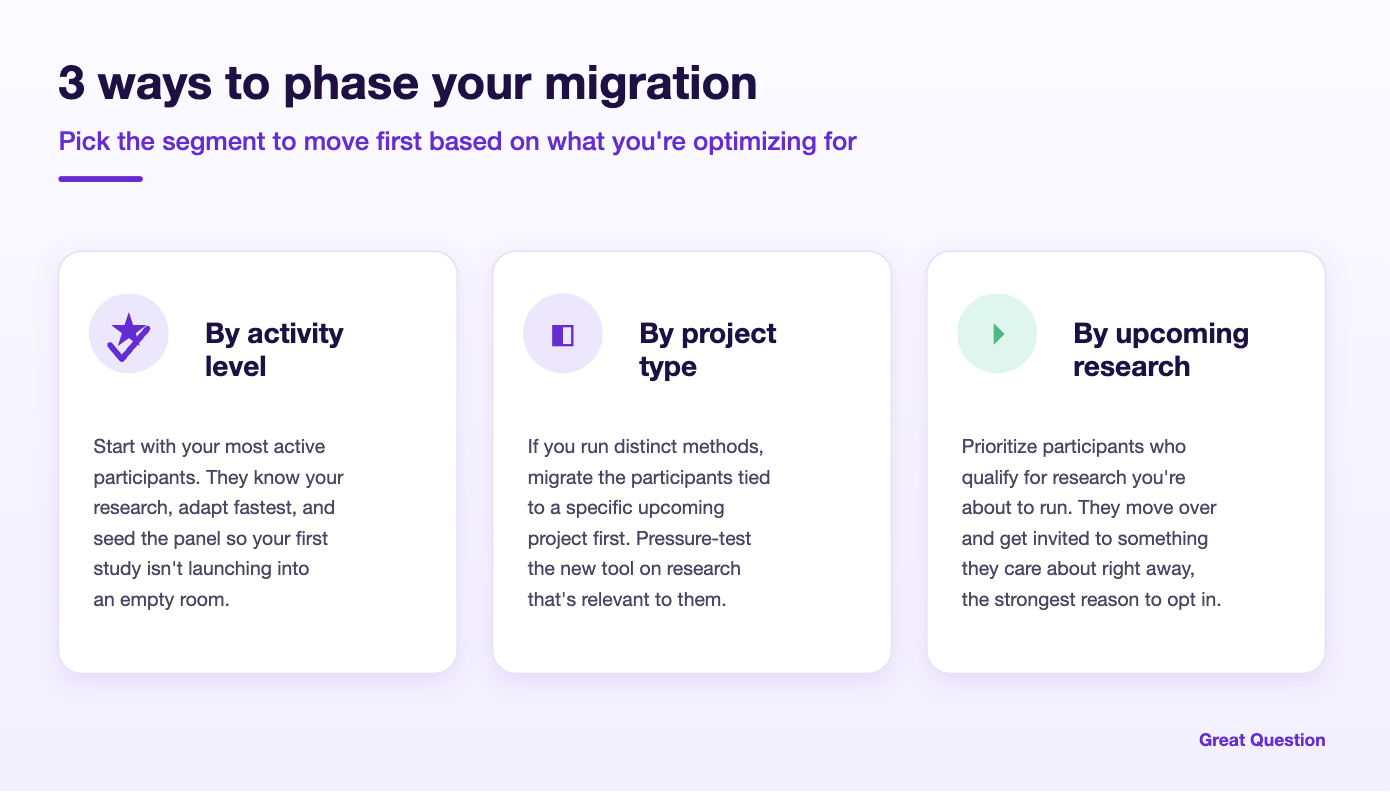
This is the recommended starting point. Refer to our article "Start building your panel" for details and other options.
Following the initial import (CSV or another method), conduct a targeted panel recruitment study within Great Question. This ensures you have the most up-to-date participant information and that participants have opted in.
Even if someone doesn't complete the new sign-up form, their information remains stored in Great Question. Using our advanced eligibility system, you can exclude participants who haven't re-opted into the study from being invited to participate.
Generally speaking, participants are not required to opt in again if they have previously consented to participate on another research platform. However, it's best to check this with your legal counsel before extracting participant data from the old system and importing it to Great Question.
With that being said, it's considered best practice to inform participants of the following:
Yes. Here it is.
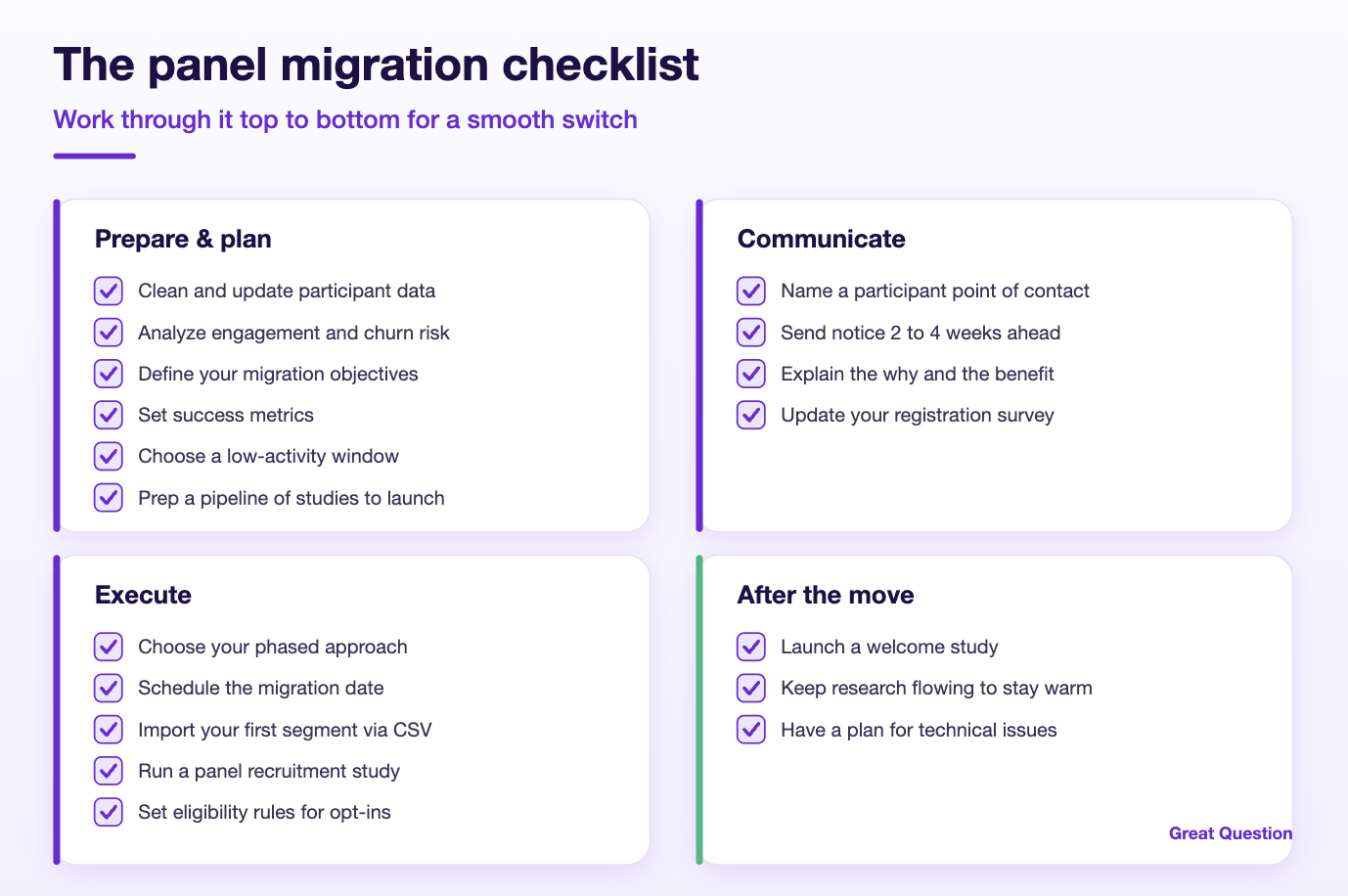
Preparation and planning
Communication strategy
Execution
Post-migration activities
Additional tasks
Read our panel management guide here.
We've helped hundreds of teams migrate their research panels without losing the participants they worked hard to recruit. If a migration is on your roadmap, book a demo and we'll walk you through exactly what your move would look like. If you own research operations, our research ops hub has more on running the function at scale.



Harri is Chief of Staff at Great Question and a former qualitative researcher at Meta. Harri works across strategy and operations, and regularly hosts conversations with research, design, and product leaders about how AI is changing the way teams understand their customers.